The Road to Camelot: Inside JFK's Five-Year Campaign by Thomas Oliphant & Curtis Wilkie
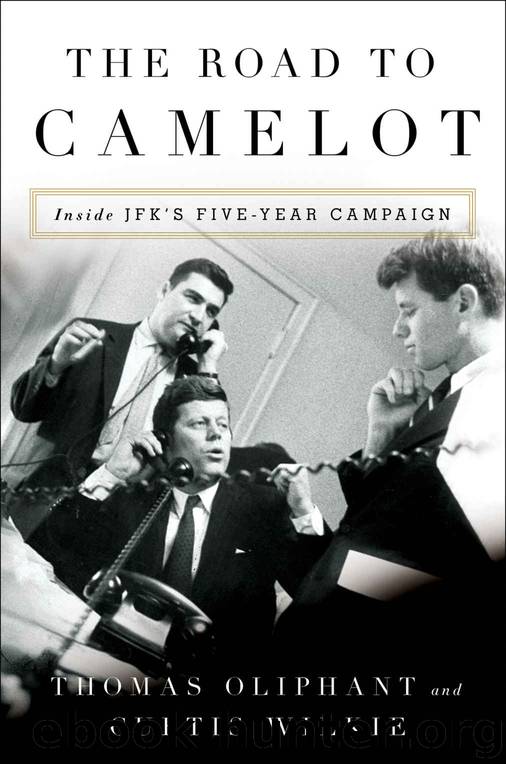
Author:Thomas Oliphant & Curtis Wilkie [Oliphant, Thomas]
Language: eng
Format: azw3
Publisher: Simon & Schuster
Published: 2017-05-09T04:00:00+00:00
CHAPTER SIXTEEN
* * *
* * *
Tying Up Loose Ends
Kennedy and his staff were proud of a campaign that relentlessly pursued delegates while navigating past many of the big-city bosses and old-time Democratic power brokers who once were able to deliver delegations, en masse, to the candidate of their choice. But there were still influential figures in some states who had to be stroked.
In Illinois, which held a nonbinding preference primary on April 12, Kennedy developed a bond with Chicago’s Mayor Daley, who had taken control of his city’s fabled political machine by muscling aside the longtime party chairman, Jake Arvey. The mayor looked doughy, with pronounced jowls, and he had a gift for malapropism, yet he had managed to establish iron rule in the nation’s second largest city. Kennedy took advantage of his important connections to Daley. Both men were Irish Catholics whose tribe had beaten the WASP establishment on its own turf. From his days in the Illinois legislature, Daley had known old Joe Kennedy, who was developing the massive Merchandise Mart on the Chicago River. The candidate’s brother-in-law Sargent Shriver not only ran the Merchandise Mart; he served as chairman of the Chicago Board of Education. Most significant, Daley liked Kennedy’s appeal to the ethnic and religious constituency of Cook County. He looked like the winner to serve at the top of a Democratic ticket, a national candidate who would help carry every local candidate on the machine slate to victory in the fall.
Winning elections meant winning power, which was essential to the reign of the Cook County Democratic Central Committee. Over the past thirty years the organization had built the most impressive political machine in American history. It was composed of men with Irish, Italian, Jewish, Polish, and other Eastern European backgrounds and filled with colorful characters, such as the saloonkeeper and Chicago alderman Paddy Bauler, who once famously declared, “Chicago ain’t ready for reform.” From the outside the machine had the odor of corruption, but inside it operated like an army, with unquestioned control flowing from the mayor’s office to every ward leader and precinct captain in the giant city. The monstrous machine fed on patronage. Party loyalty meant employment for the faithful, and Daley controlled thousands of public jobs, ensuring that he would preside over an operation that could deliver practically every precinct in the city.
Upon Kennedy’s formal announcement in January, Daley called him “highly qualified to lead our nation.” It was a signal that he was ready to deal. Kennedy won 65 percent of the popular vote in the nonbinding primary, and with Daley’s support—plus a quiet assist from Senator Paul Douglas in downstate Illinois—he would wind up with nearly 90 percent of the state’s delegation.
———
Well in advance of the Ohio primary on May 3, Kennedy had obtained the endorsement of Governor Michael DiSalle and left him alone to win the primary as a favorite son, presiding over a delegation that would be unanimously committed to Kennedy.
Yet in New Jersey, another governor, Robert Meyner, had proved intractable.
Download
This site does not store any files on its server. We only index and link to content provided by other sites. Please contact the content providers to delete copyright contents if any and email us, we'll remove relevant links or contents immediately.
| Anthropology | Archaeology |
| Philosophy | Politics & Government |
| Social Sciences | Sociology |
| Women's Studies |
The Secret History by Donna Tartt(19469)
The Social Justice Warrior Handbook by Lisa De Pasquale(12293)
Thirteen Reasons Why by Jay Asher(9119)
This Is How You Lose Her by Junot Diaz(7056)
Weapons of Math Destruction by Cathy O'Neil(6467)
Zero to One by Peter Thiel(5951)
Beartown by Fredrik Backman(5939)
The Myth of the Strong Leader by Archie Brown(5623)
The Fire Next Time by James Baldwin(5582)
How Democracies Die by Steven Levitsky & Daniel Ziblatt(5322)
Promise Me, Dad by Joe Biden(5229)
Stone's Rules by Roger Stone(5190)
A Higher Loyalty: Truth, Lies, and Leadership by James Comey(5088)
100 Deadly Skills by Clint Emerson(5023)
Rise and Kill First by Ronen Bergman(4890)
Secrecy World by Jake Bernstein(4880)
The David Icke Guide to the Global Conspiracy (and how to end it) by David Icke(4850)
The Doomsday Machine by Daniel Ellsberg(4619)
The Farm by Tom Rob Smith(4611)
